Beginner's Guide to Competitive Pinball in 2026
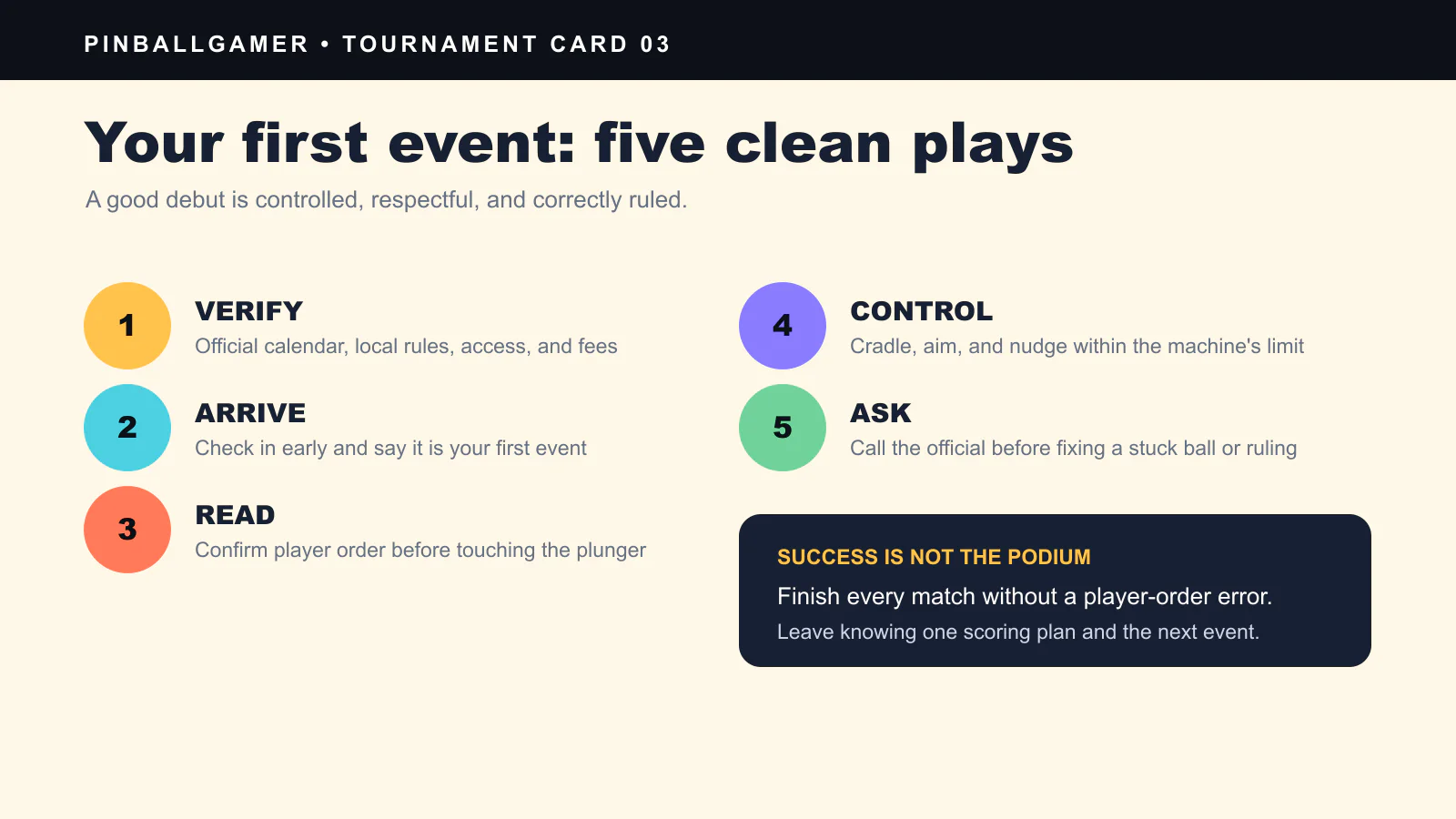
Image: PinballGamer
Competitive pinball looks intimidating because experts know the rules of dozens of machines. Your first event does not require that. It requires knowing when it is your turn, respecting the machine, reading the event rules, and asking an official before “fixing” a problem yourself.
How ranking actually works
The International Flipper Pinball Association says players earn World Pinball Player Ranking points at eligible endorsed events based on factors including field strength, participant count, format, and finishing position.
You become ranked after playing an IFPA-endorsed event and after the tournament director submits the results. Simply walking into any event does not guarantee points: the event must meet sanctioning requirements, and 2026 rules can also require minimum participation in qualifying.
Common formats
| Format | Basic idea | Beginner note |
|---|---|---|
| Group match play | Three or four players compete on assigned games over rounds | Social and easy to understand once scoring is explained |
| Head-to-head bracket | Two players compete; the winner advances | Fewer opponents, but an early exit may mean less play |
| Best-game qualifying plus finals | Players post qualifying scores, then finalists play directly | Check attempt limits and finals rules |
| Strikes or knockout | Poor finishes add strikes until elimination | Ask how ties and byes are handled |
The exact event page controls. IFPA’s 2026 ranking rules say a purely indirect high-score event without a direct-play finals component is not eligible for WPPR sanctioning, so the old claim that any “best game” session automatically counted was too broad.
Four skills worth practicing
Cradling
Holding a ball on a raised flipper creates time to aim. This is a trap or cradle.
Dead flip
A dead flip is different: leave the receiving flipper down and let the ball bounce from it toward the opposite flipper. The old article incorrectly treated “dead flip” and “cradle” as the same move.
Live catch and drop catch
These techniques use precise flipper timing to reduce the ball’s speed. Practice on a machine you are allowed to use; bad timing can turn control into an immediate drain.
Legal nudging
Moving the cabinet can influence the ball, but the machine’s tilt system and event rules set the limit. Never lift, slam, or slide a machine. IFPA rules can penalize excessive movement, and a tournament official—not the player—decides a disputed situation.
Your first-event checklist
- Find the event on the official IFPA calendar or organizer page.
- Confirm date, venue, entry fee, registration, age/access rules, format, and practice policy.
- Arrive early and tell the tournament director it is your first event.
- Check the display and player order before plunging.
- Keep hands off a stuck ball and call an official.
- Do not start another player’s ball, adjust the machine, or attempt a repair.
- Stay until your result and any tiebreak obligations are clear.
Can digital pinball help?
Digital tables can help with shot maps, mode order, terminology, and decision rehearsal. They cannot reproduce every physical machine’s pitch, wear, flipper strength, bounce, nudge response, or tournament setup.
Use simulation to learn what to shoot. Use a physical machine to learn what the ball actually does.
The right first goal
Do not make “avoid last place” the goal. Make it:
- complete every match without a player-order error;
- ask one rules question before a risky assumption;
- identify one controlled shot;
- learn one machine’s scoring plan;
- leave knowing the next event you might play.
That is a successful debut even if the standings are brutal.
Sources
- IFPA: ranking and membership FAQ
- IFPA: 2026 rankings information
- PAPA/IFPA unified tournament rules
- IFPA: WPPR v6.2 changes for 2026
- IFPA tournament calendar
Source check: 27 July 2026.
competitive pinballtournamentsIFPAbeginnerpinball skills2026